
How Much Does a Bathroom Remodel Cost in Columbus — and How Long Does It Take?
A clear, honest breakdown of 2026 price tiers, where the money goes, realistic timelines, and resale return — from the design-build team that builds these bathrooms every week.
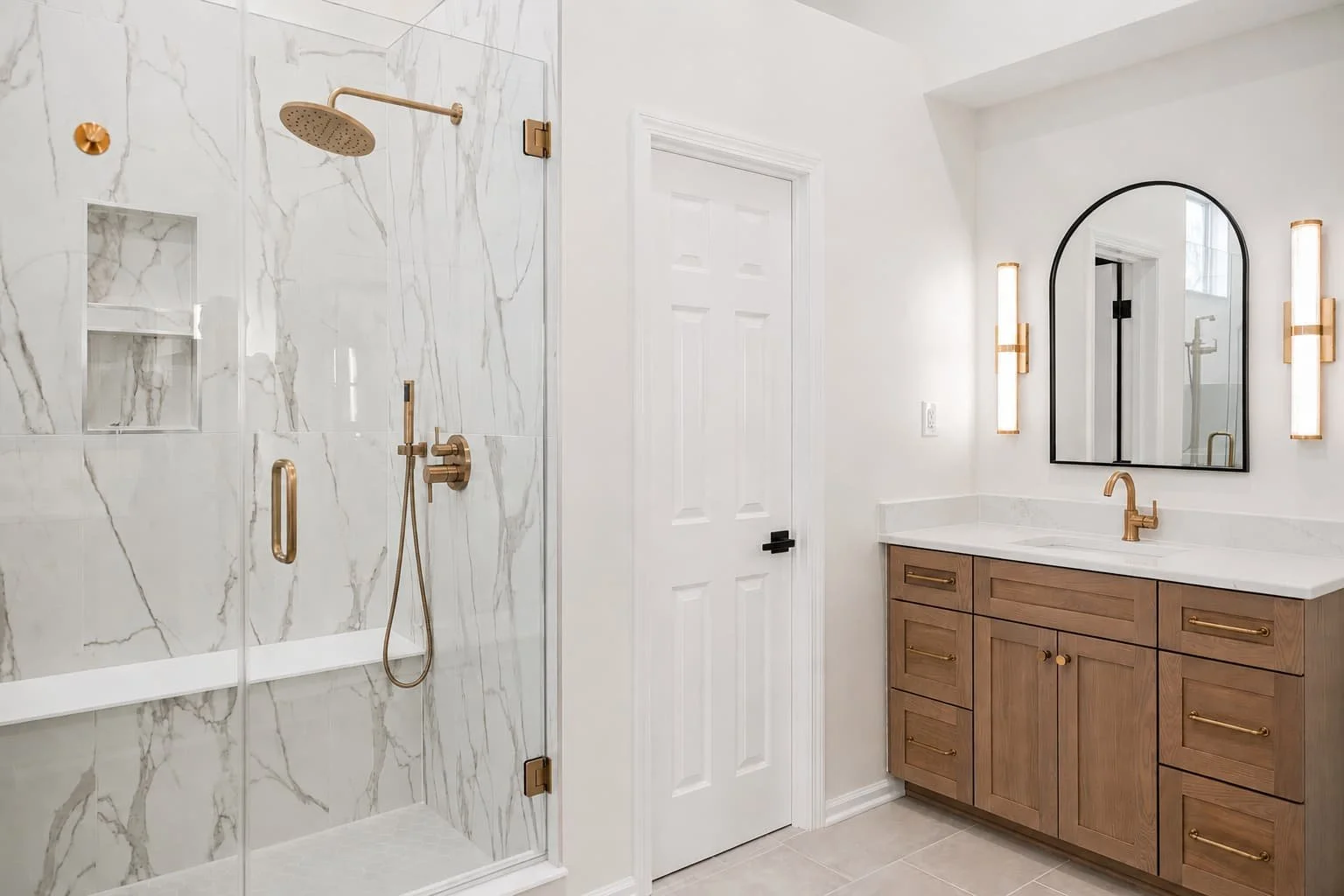
A bathroom remodel in the Columbus area generally runs $15,000 to $200,000 in 2026, and takes 2 to 18 weeks of construction, depending almost entirely on two things: how much you're changing, and the level of finishes you choose.
That's a wide range, and it's wide for a reason. A powder-room refresh and a primary-suite spa retreat with a curbless tiled shower and a custom double vanity are different projects. The good news: once you know which kind of project you're after, the number gets a lot more predictable. Below are four clear tiers from the bathroom remodeling we do across Columbus, including Upper Arlington, Bexley, Dublin, Powell, Grandview Heights, Clintonville, and Worthington.
Want a number tailored to your bathroom? Schedule a free on-site consultation — we'll walk your space and follow up with a 3D rendering and exact quote.
Bathroom Remodel Cost by Project Type (2026)
Here's the quick overview — each tier is detailed in the sections below.
| Project Type | Typical Investment (2026) | Est. Construction* |
|---|---|---|
| Powder Room / Cosmetic Refresh | $15,000 – $35,000 | 2–4 weeks |
| Full Bath — Same Layout | $30,000 – $70,000 | 5–8 weeks |
| Primary / High-EndSome layout change | $70,000 – $130,000 | 8–12 weeks |
| Luxury Primary SuiteFootprint expansion | $130,000 – $200,000 | 12–18 weeks |
*On-site build time only — excludes design, planning, and material lead times (covered below). Investment varies with size, scope, and finishes.
Powder Room / Cosmetic Refresh — $15,000 to $35,000
Surfaces and fixtures, no layout changes: new vanity, faucet, lighting, mirror, paint, and often new flooring or a tub/shower trim refresh, reusing existing plumbing locations. The most approachable way to modernize a bathroom that already functions.
Full Bath — Same Layout — $30,000 to $70,000
A complete update within the existing footprint: new vanity and storage, a new tub/shower or shower conversion, new tile, flooring, fixtures, ventilation, and lighting, with minor plumbing/electrical adjustments. Common for hall baths and many primary baths.
Primary / High-End — $70,000 to $130,000
Layout changes and upgraded materials: a larger tiled walk-in shower with frameless glass and niche details, a double vanity with upgraded counters, custom storage, heated floors, higher-end tile and specialty fixtures, and more involved plumbing and electrical.
Luxury Primary Suite — $130,000 to $200,000
The full spa retreat, often expanding the footprint into an adjacent closet or bedroom: a freestanding soaking tub, a curbless or steam shower, custom Amish vanities, natural stone, radiant heated floors, designer lighting, and fully reconfigured plumbing and structure.
Where Your Money Actually Goes
Bathrooms are more labor-intensive per square foot than almost any room in the house — small, wet, and full of trades working in tight quarters. Here's roughly how a mid-to-upper Columbus bathroom breaks down.
| Category | % of Project |
|---|---|
| Tile & shower systemUsually the biggest line item — custom tile work is slow, skilled work | 25–35% |
| Labor & project managementWaterproofing and tile setting are time-intensive | 25–35% |
| Vanity, cabinetry & countertopsFully custom Amish vanities sit at the top of this band | 15–25% |
| Fixtures & plumbingFreestanding tubs and high-end shower systems climb fast | 10–20% |
| Glass, lighting, ventilation, heated floors, paint | 8–12% |
| Design, permits & contingency | 5–10% |
What Pushes Your Number Up — and What Brings It Down
What pushes it up: moving the toilet, shower, or vanity (rerouting plumbing is the single most expensive change); expanding the footprint; converting a half bath to a full bath; custom tile work (niches, floor-to-ceiling, intricate patterns); frameless glass and custom enclosures; and premium materials like natural stone.
What brings it down — without cutting quality:
- Keep the existing layout. Leaving the toilet, shower, and vanity where they are avoids the costly plumbing reroutes.
- Choose porcelain that looks like stone. It mimics marble or slate at a fraction of the cost, is more durable, and never needs sealing.
- Reface or repaint a sound vanity box instead of replacing it.
- Pick frameless glass selectively — a half-panel or framed enclosure can deliver most of the look for less.
- Bundle with a nearby project to share mobilization, permitting, and management costs.
We build the "up" factors into your quote up front, so they're planned — not sprung on you mid-project.
How Long Does a Bathroom Remodel Take?
The construction times above are on-site build time. The full project — first meeting to finished bathroom — is longer, because of design and material lead times. Here's the honest version, in three phases.
Phase 1 — Design & planning
Selections get made and the bathroom gets drawn. For custom vanities, we produce shop drawings (about 2–4 weeks, including an on-site measure and one round of edits). Nothing gets built until those drawings are approved — that approval locks in your design and price.
Phase 2 — Material lead times (the part people underestimate)
| Material | Lead Time |
|---|---|
| Custom Amish vanityFrom approved drawings; semi-custom is 4–8 weeks | 8–12 weeks |
| TileLonger for specialty or imported stone | 2–4 weeks |
| Shower glass / frameless enclosureMeasured after tile is set — lands late in construction | 2–3 weeks |
| Freestanding tubs, specialty shower systems, fixturesIn stock; special-order is 8–12 weeks | 2–3 weeks |
The vanity and any special-order tub or stone are usually the longest poles in the schedule.
Phase 3 — Construction (on-site)
Here's how the on-site work typically sequences:
- Permits (pre-construction): 2–5 days to prepare and file, then 7–30 days for approval
- Demo and site protection: 1–2 days
- Rough plumbing: 1–3 days (relocating drains, shower valve, tub supply)
- Rough electric: 1–2 days (exhaust fan, heated-floor mat, lighting, GFCI)
- Shower pan & waterproofing: 1–3 days
- Tile — the long pole: 4–6 days for setting, grouting, and cure time, more for floor-to-ceiling or intricate work
- Vanity and countertop install: 1–2 days; 2 weeks between countertop measure and install
- Shower glass: measured after tile, installed 2–3 weeks later
- Finish plumbing & fixtures: 1–2 days
- Finish electric: 1 day
- Paint & final carpentry: 2–4 days
- Final inspection: on permitted jobs
The takeaway: plan around the lead times, not the install days. Early planning gets you the calendar you want.
Why a Bathroom Remodel Pays Off in Columbus
The straight version: bathrooms are one of the strongest interior investments in a home. Per the 2025 Cost vs. Value Report:
| Remodel Type | Cost Recouped |
|---|---|
| Mid-range bathroom remodelOne of the strongest interior returns | ~80% |
| Universal-design bathroomCurbless shower, grab bars, wider doorways | ~61% |
| Upscale bathroom remodel | ~42% |
Even fully upscale remodels recoup a meaningful share — and in Columbus's premium suburbs like Upper Arlington, Bexley, Dublin, Powell, and Grandview Heights, higher-end investments track well with what buyers now expect. Agents in these neighborhoods generally see bathrooms return in the 60–70% range.
The more useful way to think about it: for a room you use every morning, resale return is only part of the math. A primary bath you actually love earns value every single day you own the home — and still recoups a meaningful share when you sell. That's the calculation most of our clients make: build the bathroom you want to live in, and let the return come along for the ride.
2026 Price Context: Tariffs and Why Domestic Cabinetry Matters
The 25% tariffs that took effect on imported cabinets in late 2025 apply to bathroom vanities too, with further increases scheduled into 2026. Our vanities are fully custom and Amish-made in the U.S., so they're not subject to those import increases — which helps insulate one of your larger line items from tariff-driven price swings hitting projects built around overseas vanities.
How You Get an Exact Price (Not Just a Range)
The tiers above are planning ranges. You don't choose a contractor off a range, and we don't ask you to. We start with a free, on-site consultation, create a 3D rendering of your proposed bathroom, and give you an exact quote tied to a real plan — not a ballpark. The only time it changes is if you choose to add scope or upgrade beyond the original proposal. See how our Columbus bathroom remodeling process works, from consultation to final walkthrough.
Ready to see your number? Call Elevate Remodeling at 614-562-0172 or request your consultation — we'll walk your space and follow up with a 3D rendering and an exact quote. No obligation.
What Catches Homeowners Off Guard — and How We Prevent It
- Hidden water damage and rot behind showers and around toilets — extremely common in bathrooms. We assess known problem areas before quoting.
- Old or undersized venting causing moisture and mold; we plan proper ventilation.
- Asbestos or lead paint in pre-1980 homes — flagged during scoping, not discovered mid-demo.
- Out-of-level floors and walls in older Columbus homes that complicate tile and glass.
Because we finalize scope and a 3D-rendered plan before construction, these live in your fixed quote.
Why the Cheapest Quote Usually Costs the Most
A low bid usually means an under-scoped job or change orders later — and in a bathroom, the most expensive surprises hide behind tile and inside walls. We start with real design, full measurements, and a 3D rendering, so you decide from a complete picture before demo begins. You're investing in a bathroom that's right the first time, and waterproofing done correctly the first time.
Other Columbus Remodeling Costs
- Kitchen remodel: tiers, timeline, and ROI
- Basement finishing: what we build and how it works
- Whole-home renovation: designing and building a full renovation
Bundling projects with one design-build team lowers mobilization, permit, and management costs.
Frequently Asked Questions
How much does a bathroom remodel cost in Columbus, Ohio?
In 2026, roughly $15,000–$200,000 depending on scope and finishes. A cosmetic refresh runs $15,000–$35,000, a full bath in the same layout $30,000–$70,000, a high-end primary bath $70,000–$130,000, and a luxury primary suite $130,000–$200,000.
How long does a bathroom remodel take in Columbus?
On-site construction runs 2 to 18 weeks by scope. The full project takes longer due to design and material lead times — a custom vanity alone is 8–12 weeks from approved drawings, and shower glass can only be measured after tile is set. Most full bathroom remodels span a few months end to end.
Is a bathroom remodel worth it in Columbus?
A mid-range bathroom remodel recoups about 80% of its cost (2025 Cost vs. Value Report) — one of the best interior returns — while upscale remodels recoup around 42%. Beyond resale, a well-designed bathroom earns lifestyle value every day you own the home.
What's the most expensive part of a bathroom remodel?
Usually the tile and shower system, followed closely by labor — bathrooms are labor-intensive because waterproofing and tile setting are slow, skilled work. Moving plumbing is the single most expensive change you can choose.
Are vanity tariffs affecting my project?
Tariffs from late 2025 apply to imported cabinets and vanities. Our vanities are Amish-made in the U.S., so they're not subject to those import increases.
Do I need a permit to remodel my bathroom in Columbus?
Cosmetic changes (paint, hardware, fixtures in place) usually don't, but anything involving plumbing relocation, electrical changes, or structural work does. We handle permitting as part of the project.