
If you're planning a kitchen remodel in Columbus, the cabinets are the decision that shapes almost everything else — your budget, your layout, and honestly, how the whole room feels for the next 15-20 years. We get more questions about cabinets than almost any other part of a kitchen project, so we put together this overview: the different types available, standard sizing you'll want to know before you start planning, paint vs. stain, and where cabinet colors are trending for 2026.
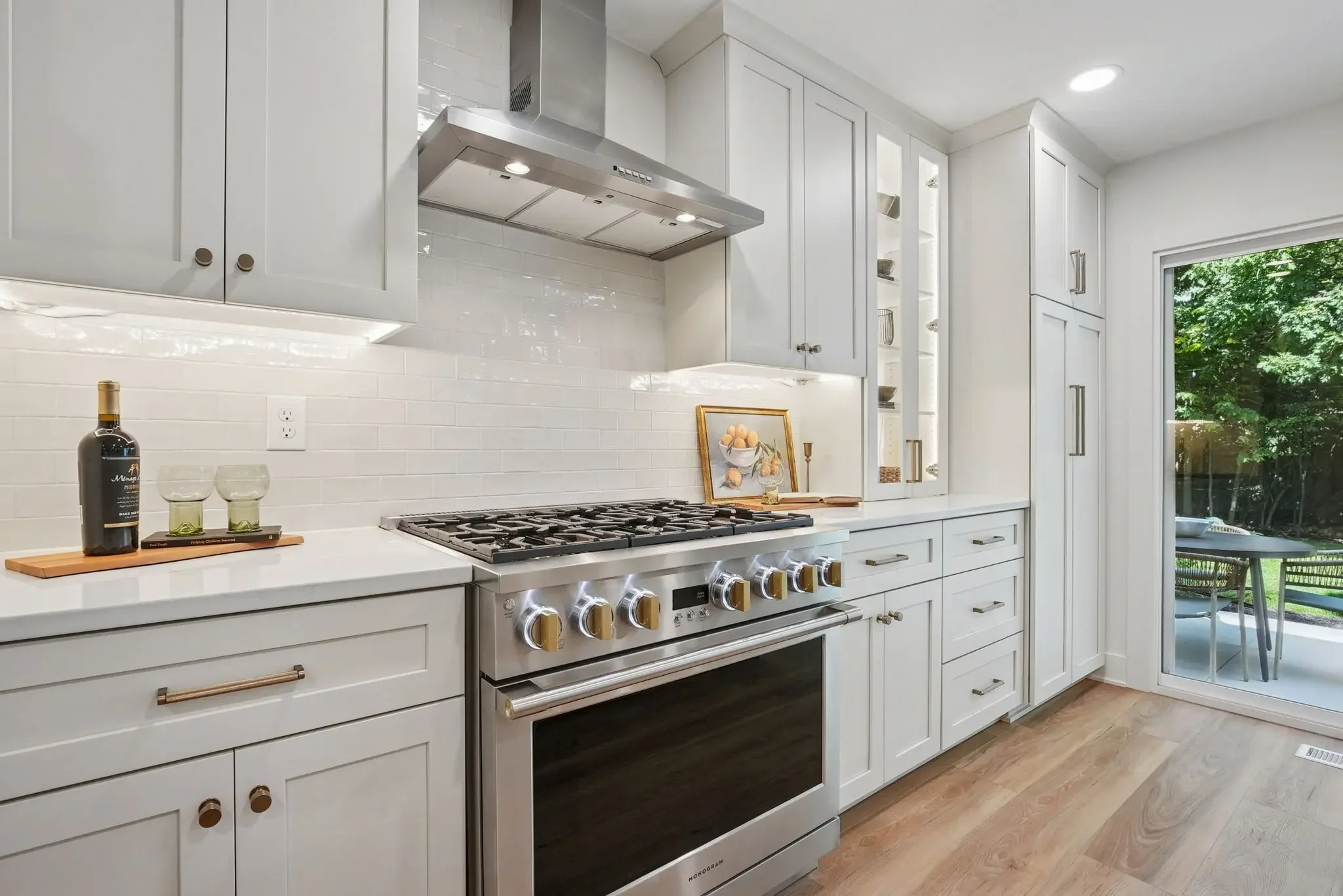
Custom, Semi-Custom, or Stock: What's the Difference?
"Custom cabinets" gets used loosely in this industry, so here's what actually separates the categories — and where the tradeoffs are.
Amish-Built Custom
- Built to your exact kitchen — any dimension, any layout quirk
- Solid wood construction, dovetail joinery, no shortcuts
- Unlimited door styles, wood species, and finish combinations
- Built by Ohio craftsmen, not a factory line
- Longest lead time, but built to last decades
Semi-Custom Cabinetry
- Standard box sizes with modifications (width, height add-ons, specialty inserts)
- Good middle ground on price and lead time
- More finish and door style options than stock
- Works well for most kitchen footprints
Stock & Ready-to-Assemble
- Fixed sizes in set increments (you design around the cabinet, not the other way around)
- Fastest and least expensive option
- Often particleboard or plywood box with a laminate or thin veneer face
- Limited customization — what you see is what you get
- Can work well for rentals, secondary spaces, or tight budgets
Why we build Amish custom by default: Most of the kitchens we see fighting an awkward layout, a weird soffit, or a too-narrow wall are the result of stock cabinetry trying to force-fit a space it wasn't built for. Custom construction means the cabinet meets your kitchen, not the reverse — which matters more in older Columbus homes than people expect.
Standard Cabinet Depths & Heights
Even with custom cabinetry, most kitchens still start from a few industry-standard dimensions — they're standard because they work well with countertop heights, appliance sizes, and how people actually move through a kitchen. Here's the baseline:
| Cabinet Type | Standard Depth | Standard Height | Notes |
|---|---|---|---|
| Base cabinets | 24" | 34.5" (36" with countertop) | Deeper for full-extension drawers and appliance garages |
| Wall cabinets | 12"–24" | 30", 36", or 42" | 42" upper cabinets are popular right now for ceiling-height storage |
| Tall / pantry cabinets | 24" | 84"–96" | Height depends on ceiling height and whether it runs to the ceiling |
| Island cabinets | 24"–36"+ | 34.5" | Deeper on the seating side for overhang and knee clearance |
| Vanity-height base (bar/prep area) | 24" | 32"–34" | Common for beverage centers or baking stations |
These numbers are a starting point, not a rule — with custom cabinetry, we adjust depth and height to fit your specific kitchen, your height, and how you actually cook. If you're 5'2" and do most of your prep standing at the island, that's worth building around.
Overlay vs. Inset: What's the Difference?
This is a construction detail that doesn't get talked about as much as color or wood species, but it changes both the look and the cost of a kitchen more than people expect.
Full Overlay
- Doors and drawers cover almost the entire cabinet frame, with only a thin reveal between them
- Clean, modern look with minimal visible frame
- Maximizes interior storage space since less frame intrudes into the opening
- The standard on most semi-custom and stock cabinetry today
- More forgiving to build, which keeps cost more moderate
Inset
- Doors and drawers sit flush inside the frame opening, like a picture in a frame
- Classic, furniture-quality look — common in high-end custom kitchens and period homes
- Requires much tighter manufacturing tolerances (gaps have to be even on all sides)
- Reduces interior cabinet space slightly since the frame sits inside the opening
- Higher cost due to the precision involved — but it's where Amish craftsmanship really shows
Neither is objectively "better" — full overlay is the practical, storage-maximizing choice for most kitchens, while inset is the look to reach for if you're going for a traditional or heirloom feel and want the cabinetry itself to be a design feature.
Storage & Organization Options
Cabinet boxes are only half the equation — what goes inside them is where a kitchen actually gets more livable day to day. These are the organization upgrades we get asked about most.
Base Cabinet Pull-Outs
- Full-extension shelves that roll out instead of requiring you to kneel and dig
- Best upgrade for any lower cabinet with a fixed shelf today
Stand Mixer Pull-Out
- Heavy-duty platform that lifts a mixer up to counter height, then tucks back down out of sight
- Popular for anyone who bakes regularly but doesn't want a mixer sitting out
Pot & Pan Organizers
- Deep drawers with peg dividers, or vertical slot storage for lids and sheet pans
- Ends the stacked-pot avalanche problem for good
Blind Corner & Lazy Susans
- Rotating or sliding shelving that reclaims the "dead corner" most kitchens lose to inaccessible depth
- One of the highest-value upgrades in an L-shaped kitchen
Trash & Recycling Pull-Outs
- Built-in bins on a slide, hidden behind a cabinet door
- Keeps bins out of sight and off the floor
Drawer & Tray Inserts
- Utensil dividers, knife blocks, and vertical slots for cutting boards and baking sheets
- Small upgrade, but it's the difference between an organized drawer and a junk drawer
Worth knowing: most of these organizers are far easier to plan for upfront in a custom cabinet build than to retrofit later. If any of these are on your wish list, mention them early in the design process — it affects cabinet depth, drawer count, and sometimes the layout itself.
Paint vs. Stain: Which Finish Fits Your Kitchen?
This is one of the most common questions we get, and it's not just a style call — it affects durability, maintenance, and how the cabinets will age.
Painted Finishes
- Opaque color hides the wood grain completely — clean, uniform look
- Works on any door style, including flat-panel and shaker
- Endless color options (see the trends below)
- Shows nicks, chips, and wear more visibly over time, especially on high-touch areas
- Professional-grade conversion varnish holds up far better than a DIY latex paint job
Stained Finishes
- Shows off the natural wood grain — no two cabinets look exactly alike
- Tends to hide daily wear and small dings better than paint
- Limited to the natural tone range of the wood species (though glazes and dyes expand this)
- Making a strong comeback for 2026 — white oak and walnut especially
- Generally requires less frequent touch-up over the life of the cabinet
We're seeing "how to paint kitchen cabinets" show up constantly in local searches right now, which tells us a lot of Columbus homeowners are weighing a DIY repaint before committing to full replacement. It's a reasonable instinct — but painting cabinets well (proper degreasing, sanding, priming, and a sprayed catalyzed finish) is a different job than painting a wall, and it's one of the few remodeling shortcuts that tends to show. If your cabinet boxes are solid and you're just tired of the color or finish, professional refinishing or refacing is often a smarter middle ground than either a DIY repaint or a full gut.
Most Popular Cabinet Colors for 2026
National design forecasting and what we're actually seeing searched for in Columbus don't tell quite the same story this year — which is worth knowing before you fall in love with a color from a design blog.
Grounded Greens
Sage, olive, and smoky jade are the top color trend among designers nationally for 2026 — treated as a new neutral rather than a bold statement.
Warm Whites & "New Neutrals"
Stark white is softening into creamy whites, mushroom, and greige. Still the most-searched cabinet color in Columbus by a wide margin.
Muted Blues
Dusty blue, denim, and smoky indigo are gaining ground, especially as an island or lower-cabinet accent color.
Natural Wood Stains
White oak and walnut are back after years of all-painted kitchens — often paired with painted uppers in a two-tone layout.
| Color | Brand & Code | Family | Why It's Trending |
|---|---|---|---|
| White Dove | Benjamin Moore OC-17 | Warm White | The most-recommended cabinet white in the country — warm and creamy without going stark |
| Alabaster | Sherwin-Williams SW 7008 | Warm White | Slightly creamier than White Dove, feels custom on shaker doors |
| Evergreen Fog | Sherwin-Williams SW 9130 | Soft Green | A restorative grey-green — one of the most-specified "new neutral" greens for perimeter cabinetry |
| Pewter Green | Sherwin-Williams SW 6208 | Dark Green | Cool and metallic, pairs exceptionally well with natural wood tones and brass hardware |
| Clary Sage | Sherwin-Williams | Sage Green | Sage has fully crossed from trend to mainstream — reads as a neutral while still bringing color |
| Naval | Sherwin-Williams SW 6244 | Navy | The classic maritime navy — the top choice for a dramatic, high-contrast two-tone kitchen |
| Hale Navy | Benjamin Moore HC-154 | Navy | Slightly warmer and softer than Naval, reads as navy rather than black in low light |
| Revere Pewter | Benjamin Moore HC-172 | Warm Greige | A warm greige with a subtle green-gray base, pairs beautifully with white countertops |
| Agreeable Gray | Sherwin-Williams SW 7029 | Greige | The most popular greige in America — reads warm or cool depending on your kitchen's light |
| Tricorn Black | Sherwin-Williams SW 6258 | Black | A true, deep black for a high-contrast, gallery-like backdrop behind brass hardware |
| Iron Ore | Sherwin-Williams SW 7069 | Charcoal | Reads as black but feels softer — a velvety, less severe alternative to true black |
One nuance worth flagging: our own local search data shows white cabinets still holding the highest search interest by far in the Columbus area, while black and green searches have actually trended down slightly over the past few months — even as green is the color designers nationally are pushing hardest. Our read: national trend pieces move faster than most homeowners' actual decisions. White, off-white, and warm neutrals remain the safe, resale-friendly choice here, while green, navy, and two-tone layouts are the ones to consider if you want your kitchen to feel current five years from now rather than just today.
A Few Directions Worth Considering
Two-tone kitchens — lighter uppers with a deeper lower cabinet or island color — are one of the lowest-risk ways to bring in a trend color without committing the whole room to it.
Matte finishes are outperforming high-gloss right now, especially on darker colors.
Statement islands let you experiment with green, navy, or even a deep red without touching the perimeter cabinetry.
Not Sure Which Direction Fits Your Kitchen?
We build 3D renderings of your actual kitchen before anything gets built, so you can see cabinet style, finish, and color in your own space — not just on a screen.